Who was Sir Thomas Tancred?
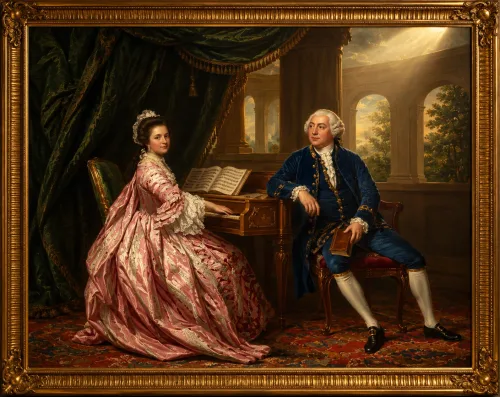
A double portrait of the married couple survives: Sir Thomas Tancred (d. 1784) and his wife Penelope (d. 1837), daughter of Thomas Ashton (or Assheton) Smith, within an arcaded setting, depicting the lady seated at a square piano, her husband upon a chair holding a book. This attractive double portrait was probably painted around the time of their marriage in October 1776.
The Tancred, later Lawson-Tancred, Baronetcy of Boroughbridge in the County of York is a title in the Baronetage of England, which was created in November 1662 for Thomas Tancred. He was a descendant of Richard Tankard, who shortly after the Norman Conquest owned lands at Boroughbridge in North Yorkshire.
Sir Thomas Tancred, 5th Baronet of Boroughbridge, was born at Brampton, Aldborough in Yorkshire, was educated at Oxford, and received the degree of D.C.L. in 1773. He was called to the Bar from Gray’s Inn in 1775. He inherited the baronetcy in 1759 and died on 5 August 1784. He married Penelope Assheton-Smith in 1776; their son, the future 6th Baronet, was born in 1780.
So, when we encounter Tancred as a Mason in the 1770s, we are dealing with a Yorkshire baronet, landed gentleman and barrister.
His place within Freemasonry
On 14 February 1770, Sir Thomas Tancred was admitted to the Lodge of Friendship No. 6 in London. The lodge’s surviving register records his admission, alongside other aristocratic and distinguished Masonic figures.
In 1771, Grand Lodge appointed Tancred as the Provincial Grand Master for Yorkshire. The modern Provincial Grand Lodge history records that the appointment was probably connected with James Heseltine, the Yorkshire-born Grand Secretary of the Premier Grand Lodge in London. It describes Tancred as the first Provincial Grand Master appointed for the whole county, in what was a new phase of Yorkshire Masonry.
The provincial system was in a primitive stage, with the Provincial Grand Master essentially being Grand Lodge’s local representative. If we imagine the elaborate organisation of Victorian Freemasonry, the phrase “Provincial Grand Lodge” is not comparable to its modern counterpart. The Yorkshire Provincial Grand Lodge itself explains that in this period there were originally no Provincial Grand Officers or regular Provincial meetings, and a Quatuor Coronatorum study of 1929 found that Tancred did not appear to have been particularly active in the early years following his appointment: no Provincial meetings were held for three years, and Provincial officers were not appointed until 1774. The foundation of Apollo Lodge No. 450 in York in 1773 was to transform Tancred’s position, and gives us a clue to his style of leadership.
Apollo Lodge No. 450 was warranted by the Premier Grand Lodge “Moderns” on 31 July 1773. Tancred conducted the work of his province through the medium of the Apollo Lodge, with Apollo becoming the operations department of the Provincial Grand Lodge of Yorkshire. The Apollo officers were simultaneously Provincial officers. Provincial business was transacted through Apollo, with the Apollo Lodge seal being used on Provincial documents. So although Tancred’s name is at the head of the Provincial organisation, the men who operated it were principally the brethren of Apollo Lodge No. 450, with Tancred being a patron and constitutional authority rather than a hands-on lodge manager. He provided aristocratic status, Provincial authority, his signature, access to Grand Lodge, and legitimacy, with the brethren of Apollo fulfilling the day-to-day work such as meetings, administration, records and correspondence.
This is the period when Tancred’s undertakings become historically important. York already possessed the much older Grand Lodge of All England at York, which claimed an independent Masonic tradition. Tancred’s Provincial Grand Lodge represented the Premier Grand Lodge of England in London. So he was effectively establishing a competing or alternative constitutional structure in a city which regarded itself as the home of English Masonry. The Apollo Lodge became the principal instrument of that expansion.
In December 1774 Tancred summoned “the officers and brethren of the different lodges … under the Constitution of the Grand Lodge of England” to meet at the Apollo, George Inn, Coney Street, York, under his authority.
In 1776 Royal Oak Lodge No. 495, Ripon, was warranted under his authority.
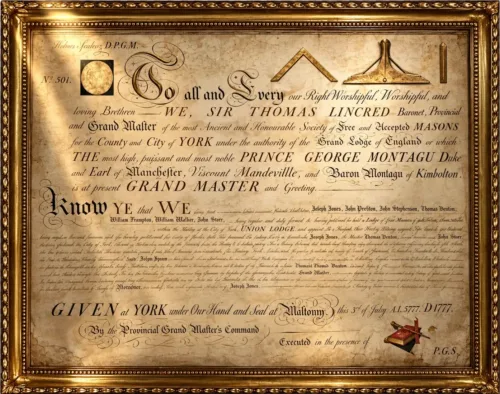
1777: The Warranting of Union Lodge No. 504 (future York Lodge 236)
On 7 July 1777, the warrant for Union Lodge No. 504 (which became York Lodge No. 236) was issued, signed by Sir Thomas Tancred, Bt., Provincial Grand Master for the County of York — making Tancred, in a sense, the constitutional godfather of York Lodge 236.
The lodge’s seven founders were:
- Joseph Jones — plane maker
- Thomas Denton — bookseller
- John Stephenson — mariner
- William Thompson — whip maker
- John Preston — musical-instrument maker
- William Walker — farmer
- John Stow — mariner
Tancred was a baronet and landed gentleman. The men whose lodge he authorised included artisans, tradesmen, a farmer and mariners — demonstrating the evolving status of membership of the fraternity, connecting the landed elite with the urban middle classes.
1778: York Masonic Rivalries
On 24 June 1778, Grand Master William Siddall called the brethren of the old York Grand Lodge to meet at the York Tavern. Surviving newspaper evidence shows that Tancred summoned the Provincial brethren to meet on the same day at Nicholson’s Coffee House in Coney Street, under the London constitution. York had two rival Masonic authorities meeting on the same day:
- Grand Lodge of All England at York — Grand Master William Siddall
- London/Modern Provincial Masonry — Provincial Grand Master Sir Thomas Tancred
Whether this was a deliberate move, and who acted first, are moot points which are lost in the depths of time, though the rivalry was playing out visibly on the streets and social life of York. The challenge had been placed before the brethren to choose.
In December 1778 Tancred summoned the brethren to Nicholson’s Coffee House, to proceed to St Martin’s Church, Coney Street, to hear a sermon from Rev. William Johnson, Provincial Grand Chaplain, and afterwards to dine — demonstrating that the Provincial organisation already had something approaching an officer structure, and that the Provincial system was becoming an actual institution: Provincial Grand Master Tancred, Provincial Grand Chaplain William Johnson, subordinate lodge officers, public processions, religious observances and formal dinners.
In 1779 Tancred was succeeded by Sir Walter Vavasour, Bt., who summoned the Provincial brethren to Nicholson’s Coffee House on 24th June.
What happened to Tancred after 1779?
He did not disappear from Freemasonry, but his period as Provincial Grand Master was over. Sir Walter Vavasour succeeded him. Vavasour himself had been initiated into the old York Grand Lodge in 1768 and subsequently joined Apollo on 24 June 1779.
There is no evidence that he held a major English Grand Lodge office in London after his Yorkshire Provincial Grand Mastership. His Masonic significance is overwhelmingly provincial and Yorkshire-based, rather than a career culminating in Grand Master, Deputy Grand Master, and so on.
What did Tancred achieve?
He wasn’t the greatest ritualist or lodge administrator of 18th-century Yorkshire. The surviving evidence suggests he was not particularly active in the first years of his appointment. But he did three enormously consequential things which made the London system permanent and respectable in York.
- He gave Premier Grand Lodge Masonry aristocratic legitimacy in Yorkshire — a baronet from an ancient Yorkshire family stood at its head, which mattered enormously in an 18th-century society in which rank and patronage were important sources of institutional legitimacy.
- He established an operational network. Apollo Lodge became the practical centre of the province. From there came provincial meetings, warrants, officers, correspondence, ceremonies and the establishment of new lodges.
- He authorised Union Lodge No. 504, which became York Lodge No. 236. The warrant of Union Lodge 504, dated 7 July 1777, bears Tancred’s authority. That lodge survived every subsequent renumbering (504 – 409 – 410 – 423 – 331 – 287 – 236) to become York Lodge No. 236 in 1870.
The remarkable historical irony is that the lodge created under Tancred’s authority eventually became one of the principal custodians of the records and heritage of the old York Masonic tradition which his constitutional system had helped displace.
Research by W Bro Mark Barratt, September 2026.
Note
The Grand Lodge of All England, the Grand Lodge of All England at York, the York Grand Lodge, the Grand Lodge of York, and the old York Lodge are just a few variations of the name for York’s original Lodge, which existed before the London Grand Lodge of 1717.
Some older sources date Tancred’s tenure from 1771, while some accounts describe him as having acted in the capacity from 1774. The discrepancy seems to reflect the difference between his appointment and the point at which he actually began actively operating a revived Provincial organisation.
Chronology
- 1770: Admitted to Lodge of Friendship No. 6, London, on 14 February.
- 1771: Appointed Provincial Grand Master for Yorkshire.
- 1773: Apollo Lodge No. 450 founded at York; it subsequently becomes the working centre of Tancred’s Provincial administration.
- 1774: Tancred begins actively summoning the Yorkshire brethren and building a Modern Masonic structure in York.
- 1777: Warrant issued for Union Lodge No. 504, the future York Lodge 236, bearing Tancred’s signature.
- 1778: Tancred continues to summon Provincial brethren at Nicholson’s Coffee House, and organises religious observances with his Provincial Chaplain.
- 1779: Succeeded as Provincial Grand Master by Sir Walter Vavasour.
- 1784: Died on 5 August. Succeeded by his son Thomas, the 6th Baronet.