By W. Bro Paul Cottingham
When we look back through the history of Freemasonry, it is tempting to imagine our predecessors as universally respectable gentlemen: upright citizens, pillars of their communities, and perfect examples of the principles they professed. History, however, is rarely that tidy. Among the founder members of what is today York Lodge No. 236 was a man whose remarkable life encompassed bookselling, mechanical invention, automata, chemistry, conjuring and mathematical instruments, and which ultimately ended with a journey to the gallows at Newgate. His name was Thomas Denton.
A Founder of Union Lodge
The Lodge we now know as York Lodge No. 236 began life as Union Lodge. On 30 April 1777, Joseph Jones, John Preston, John Stephenson, Thomas Denton, William Walker, William Thompson and John Stow petitioned the Provincial Grand Lodge of Yorkshire for authority to establish a lodge in York. A dispensation followed on 20 June, and the warrant was dated 7 July 1777.
The Lodge’s own historical records identify Denton, a bookseller, as one of its seven founders and as its first Senior Warden. The following year he succeeded Joseph Jones and became the Lodge’s second Worshipful Master, serving in 1778. A Masonic account published as early as 1875 independently records Denton among the original petitioners and confirms his appointment as Senior Warden when Union Lodge was constituted.
There can therefore be little doubt about Denton’s importance in the earliest history of our Lodge. What happened afterwards is considerably less conventional.
More Than a Bookseller
Thomas Denton appears to have been an extraordinarily capable man. The nineteenth-century Dictionary of National Biography records that he came from the North Riding of Yorkshire and initially trained as a tinman before establishing himself as a bookseller in York. His interests extended well beyond the selling of books, particularly into mechanics and scientific subjects.
Around 1780, after his period of greatest involvement with Union Lodge, Denton moved to London, where he reportedly encountered a mechanical “speaking figure” being exhibited in St James’s. Rather than simply admiring it, Denton studied its construction and decided that he could build one himself. According to the later Newgate account, he succeeded, and subsequently toured the country exhibiting his mechanical figure before constructing an even more ambitious writing automaton, a machine capable of imitating the act of writing. Although some of the colourful descriptions preserved in the Newgate Calendar should be treated with caution, since that publication was intended partly to entertain and moralise, Denton’s reputation as an ingenious mechanic is supported by later biographical sources.
He also manufactured pantographs and other mathematical instruments, developed an interest in chemistry, and became involved in metal plating. Perhaps most surprisingly, in 1784 Denton translated a work associated with the celebrated Italian conjuror Giuseppe Pinetti, dealing with physical amusements, experiments and what we would today call stage magic or scientific entertainment.
This was no ordinary eighteenth-century bookseller. Denton was an inventor, mechanic, entrepreneur and experimenter. Unfortunately, precisely the same technical abilities that made him remarkable would eventually destroy him.
From Metalwork to Counterfeiting
While in London, Denton combined bookselling with metal plating and mechanical work. The traditional account says that through the plating trade he encountered people involved in producing base or counterfeit coin, and that his skill in working metals and constructing precision mechanisms made him exceptionally well suited to such work. At this point his story moves from ingenuity into criminality.
Counterfeiting money in eighteenth-century Britain was regarded with extraordinary seriousness. Coin was not merely private property: it represented the authority of the Crown and the integrity of the national economy, and certain forms of counterfeiting could therefore fall under the law of high treason, exposing offenders to capital punishment.
Denton became associated with a known coiner and was eventually prosecuted. The surviving biographical accounts report an extraordinary detail: his counterfeit coins were supposedly made so skilfully that proving conclusively that particular specimens were false became difficult, and his trial was said to have lasted around seven hours.
Ultimately Denton was not convicted simply on proof that he had passed a particular counterfeit coin; he was convicted of possessing the implements used for coining. Under the law of the period, that was sufficient to send him to the gallows. The very mechanical ingenuity that had allowed him to construct automata and scientific instruments had apparently been redirected towards machinery capable of manufacturing false money.
The Money of the Day
The coins Denton was accused of counterfeiting would have been silver shillings and gold guineas of exactly this kind — George III coinage bearing the King’s Latin title, GEORGIVS III DEI GRATIA, “George the Third, by the grace of God”.
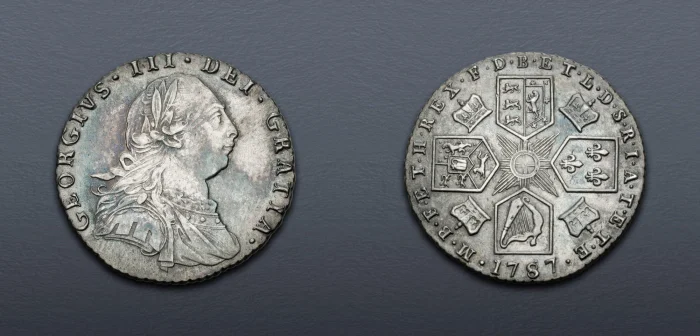
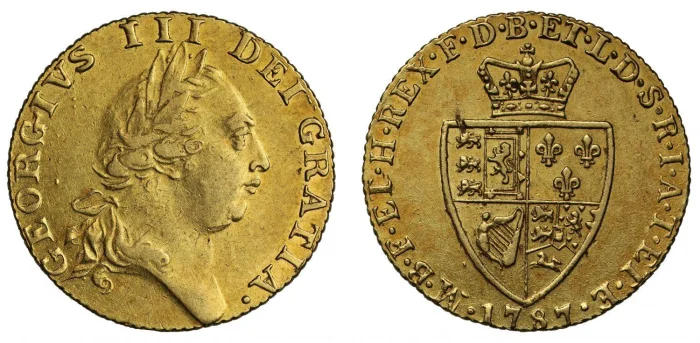
A guinea was worth twenty-one shillings, and both coins were struck in precious metal, which is precisely why they were worth counterfeiting, and why the law treated counterfeiting them so severely.
The Wider Fight Against Forgery
Denton’s own conviction was for coining, not for forging paper money, but the two problems were closely related, and the same decade saw a surge in one as much as the other. Features intended to make banknotes harder to copy have always been part of their design. In 1797, gold shortages caused by the French Revolutionary Wars (1792–1807) led the Bank of England to rush out £1 and £2 banknotes for the first time. Counterfeiting surged, as forgers took advantage of the public’s unfamiliarity with the new notes and their poor print quality.
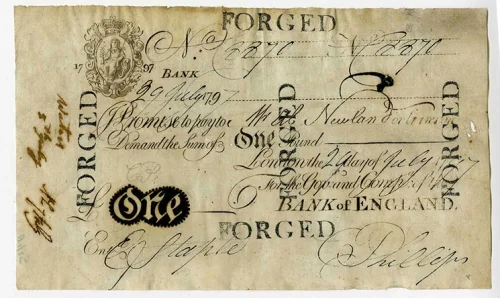
This printed counterfeit £1 note was seized by Bank of England clerks and stamped repeatedly with the word “forged”, in the same way that a counterfeit coin of Denton’s day might be defaced or cut once its true nature had been discovered. It stands as a reminder that Denton was one participant, however skilled, in a much wider eighteenth-century struggle between the Crown’s currency and those prepared to imitate it.
Newgate
Denton was imprisoned in Newgate and sentenced to death. The Dictionary of National Biography records that he was hanged outside Newgate alongside his associate John Jones and two other condemned prisoners on 1 July 1789. The traditional Newgate Calendar gives the same date, though York Lodge’s own history page instead records 6 July, so a minor discrepancy survives in the secondary sources.
The Victorian and Georgian accounts become particularly moralistic when describing Denton’s final hours, depicting him as an “infidel” who showed insufficient repentance. We should be cautious about accepting such judgements literally, since accounts of executed criminals were often written deliberately to provide readers with a moral lesson.
One detail, however, is particularly moving. The traditional account records that shortly before being taken to execution, Denton asked for pen, ink and paper and wrote to his parents. The surviving version has him absolving his wife of responsibility for his fate, acknowledging that had he followed her advice he would not have found himself awaiting execution. Behind the sensational story of the ingenious counterfeiter was therefore a husband, father and son facing the consequences of his own decisions.
His Portrait
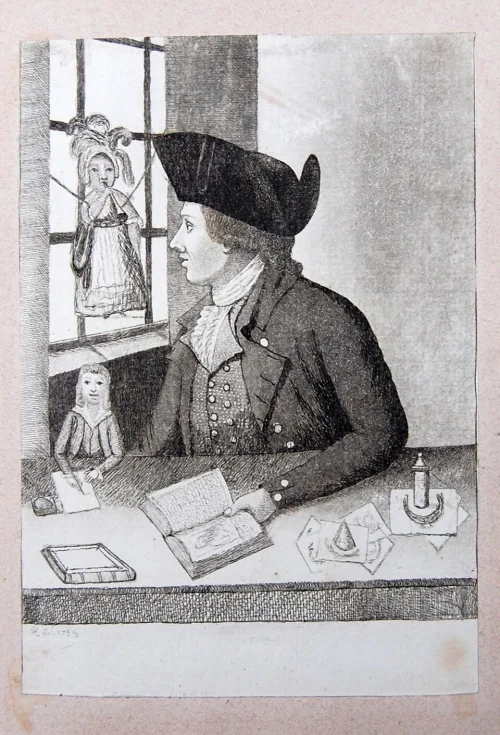
© The Trustees of the British Museum. Shared under a Creative Commons Attribution-NonCommercial-ShareAlike 4.0 licence.
A portrait of Denton survives in the collection of the British Museum: an etching with aquatint dated 1785, titled Mr. Denton with Speaking Figure, was hanged in London for Coining. It shows him seated half-length at a table, holding an open book showing a small figure that itself holds a pen to a piece of paper — presumably his writing automaton — while he looks away to his left at a female doll hung in front of the window, apparently playing a trumpet. A mirror, playing cards and other small objects lie on the table at his elbow.
The title given to the print by its later owners ties the two halves of Denton’s story together in a single line: the ingenious maker of speaking and writing automata, and the man hanged in London for coining.
A Mason, But Still a Man
There is an important point in telling Thomas Denton’s story. Freemasonry did not make him a criminal, any more than membership of a church, guild, profession or civic body guarantees virtue. Freemasonry provides principles; whether a man follows those principles remains his own responsibility.
Denton had occupied the Senior Warden’s chair of Union Lodge, and then the Master’s chair itself. He would have been familiar with precisely the same broad concepts that remain recognisable to Freemasons today: integrity, morality, self-improvement and responsibility towards one’s fellow man. Yet approximately eleven years after serving as Worshipful Master, he stood condemned at Newgate.
There is something deeply human in that contradiction. Indeed, Denton’s story arguably tells us something important about why the moral lessons of Freemasonry exist in the first place: they are not bestowed on a man simply because he wears an apron or occupies a chair. They require continual application. The working tools may provide the allegory, but the individual must still use them.
Genius Misapplied
Denton’s tragedy is perhaps best understood not simply as the story of a dishonest man, but as the story of extraordinary talent misdirected. Consider what he appears to have achieved: a tradesman from Yorkshire who educated himself sufficiently to become a bookseller, studied mechanics, constructed automata, manufactured mathematical instruments, experimented with chemistry, translated technical material from another language, and mastered sophisticated metalworking.
In another life those abilities might have established Thomas Denton as a respected inventor or scientific instrument maker. Instead, his talents were eventually employed in counterfeiting currency. The old Newgate literature summarised his life as one of “misapplied talents”, and for once, beneath the moralistic language, there is a perceptive observation. Denton did not apparently lack intelligence. He lacked judgement.
One of Our Own
For York Lodge No. 236, Thomas Denton should not be erased or quietly forgotten. Quite the opposite: he was there at the beginning. His name belongs beside Joseph Jones, John Stephenson, William Thompson, John Preston, William Walker and John Stow among the founders of Union Lodge. He served as our first Senior Warden and our second Worshipful Master.
But acknowledging him does not require us to sanitise his life. History becomes considerably more interesting when we allow its characters to remain human. Thomas Denton was a Freemason. He was also a gifted mechanic, entrepreneur and bookseller. And he was a convicted criminal who died on the gallows. Those facts can coexist, and perhaps that is ultimately the lesson his story leaves us.
The Craft has never claimed that every man who entered a Lodge became perfect; its symbolism instead asks men to recognise their imperfections and work upon them. Thomas Denton’s considerable talents could construct machines, imitate handwriting, manipulate metals and apparently reproduce coinage with remarkable skill. But the most difficult piece of work remained unfinished: the man himself.
A note on our sources
Research for this article draws particularly on the surviving history of York Lodge No. 236, an 1875 Masonic Magazine account of the founding of Union Lodge, the nineteenth- century Dictionary of National Biography, and material subsequently preserved in contemporary accounts of the Newgate prisoners. The Newgate material is valuable but should be read with some caution, since such publications combined factual criminal reporting with moralising and sensational narrative. Where sources disagree — as over the exact date of Denton’s execution — this article notes the discrepancy rather than resolving it by guesswork. The 1785 portrait is drawn from the collection of the British Museum, and the account of the 1797 counterfeit banknote from the Bank of England’s own published material on the history of forgery; neither the coins nor the banknote pictured are claimed to be pieces connected to Denton personally, and are included as illustrations of the currency and the forgery of his period.
Image rights and uses
- Portrait of Thomas Denton, 1785 — © The Trustees of the British Museum. Used under a Creative Commons Attribution-NonCommercial-ShareAlike 4.0 International licence: free to share and adapt for non-commercial use with credit to the British Museum. We were unable to confirm the exact catalogue page for this print; if you can identify it, please let the Lodge Secretary know so the credit can be made more precise.
- George III shilling and guinea, 1787 and counterfeit £1 banknote, 1797 — included for non-commercial historical illustration of the coinage and paper currency of Denton’s period. Copyright in each image remains with its own rights holder; please contact the Lodge Secretary if you hold rights in one of these images and have a concern.
See also the site’s general Copyright & Image Rights page.