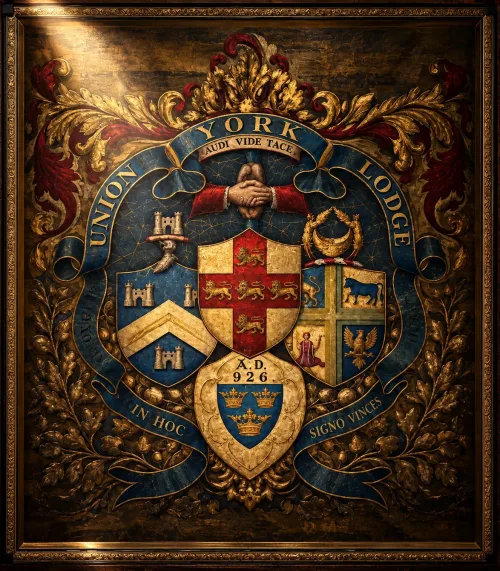
The York ‘Union Lodge’ Banner
Behind the Master’s Chair hangs the York ‘Union Lodge’ Banner. It was presented to York Lodge in November 1855 by six members of the Lodge:
- Robert Farrah, Sharebroker
- Robert Walker, Solicitor
- William Jancowski, Wool Merchant
- George Hornby, Surgeon
- John Simpson, Corn Miller
- Richard Smith, Solicitor
The arms of the City of York are deliberately placed on top or in front of the other emblems, with the hands on top of these again. Symbolically this asserts the importance of York in both: (1) the unification of the Antient & Modern orders, and (2) the significant Masonic heritage associated with the City of York.
In the centre, below York, is the UGLE “motto” AUDI VIDE TACE, translated as “hear, see and be silent”.
The clasped hands (centre top)
These hands represent the Union of the Antient and the Modern Masonic orders. The ‘Antient’ Grand Lodge of All England had been in existence in York before the union, as a challenger to the authority of the ‘Modern’ Lodge.
The four devices
The Banner is a quartering of four devices:
1. The arms of the City of York (centre)
Five gold regal lions of England passant on the Red Ensign of St George as the chief charge upon a silver shield.
2. The arms of the Grand Lodge of All England (bottom)
Three coronets on an azure field, known as Prince Edwin’s arms; above, three crowns being the year A.D. 926. The design is to be found on a brass seal in the possession of York Lodge, circa 1775. The old York Masonic seal bears three regal crowns, with the inscription Sigillum Edwini Northum. Regis. The York tradition associated those arms with Prince Edwin and the legendary A.D. 926 assembly.
3. The arms of the ‘Moderns’ (left)
A blue field with silver chevron between three silver castles, on the chevron a pair of compasses. These arms were adapted from those of the Worshipful Company of Masons, one of the City Livery Guilds: the field was originally sable and the chevron engrailed. The arms were granted in 1742.
A crest is now shown upon the helm, without torse, a castle as in the arms. The motto was “in the Lord is our trust”.
4. The arms of the ‘Ancients’ (right)
A cross on cross, with four quarters: (1) a lion rampant; (2) an ox; (3) a man with hands erect, proper, robed in crimson and ermine; (4) an eagle. On the crest of the arms is the Ark of the Covenant, supported by Cherubim.
- The lion represents courage and strength (the tribe of Judah).
- The ox represents patience, assiduity and service (the tribe of Ephraim).
- The man with hands erect, robed in crimson and ermine, represents humanity, intelligence and understanding (the tribe of Reuben).
- The eagle represents promptness, spiritual vision and celerity (the tribe of Dan).
They also correspond to the four evangelists:
- The Lion – St Mark
- The Ox – St Luke
- The Man – St Matthew
- The Eagle – St John the Evangelist
W Bro Mark Barratt, Worshipful Master, 2026